During the evolution of industrial automation, a simple rule has always held true: the larger the equipment, the greater the energy demand.
As railway bridge inspection robots conduct operations in the wild, steel mill metallurgical vehicles operate continuously in high-temperature environments, and large inspection equipment for photovoltaic power stations shuttle back and forth on the Gobi Desert - these "heavyweights" are demanding charging speeds that are breaking through the boundaries of traditional wireless charging technology.
WIRELESSPT recently launched the 6000W-48V-100A integrated wireless charger (model LYAG600100M-D060V20-T/R), which boosts the charging current to 100 amperes. This means that unmanned vehicles and large inspection robots that need to frequently travel to charging stations now have a faster way to replenish energy.
The value of high current: Let heavy equipment bid farewell to "charging anxiety"
In industrial scenarios, charging speed directly affects equipment utilization. For a steel plant AGV that needs to operate continuously for 24 hours, every 10 minutes reduction in charging time means nearly 1 hour of additional effective working time each day.
Data shows that the rated output current of the WIRELESSPT6000W wireless charger reaches 100A ± 2A, and the rated output voltage range is 40-60VDC. Within the standard working distance, the system can maintain full-load output, and the maximum transmission efficiency is not lower than 85%. This means that heavy equipment with large-capacity batteries can complete energy replenishment in a shorter time, reducing production interruptions caused by charging.
"We have observed a trend: mobile robots are becoming increasingly 'heavy'." said Li Dan, the founder of WIRELESSPT. "Whether it's an outdoor photovoltaic cleaning robot or a track RGV in the steel plant, their battery capacity has grown from dozens of ampere-hours to hundreds of ampere-hours. If the charging speed cannot keep up, the equipment can only 'queue up' in front of the charging station, which is a significant loss to production efficiency."
Reliable Design under Extreme Conditions
For heavy-duty robots operating outdoors, the reliability of charging equipment is often more important than charging speed. The WIRELESSPT6000W product takes into account the challenges of harsh conditions during its design.
In terms of protection level, the transmitter reaches IP65 and the receiver reaches IP67. It can completely prevent dust and operate normally in 1 meter of water depth. The working temperature range covers -40°C to 60°C. Whether it's the extremely cold northern winter or the intense sun exposure on the desert, the equipment can operate stably.
In terms of installation fault tolerance, the product supports a horizontal offset range of ±50mm for the X-axis and ±10mm for the Y-axis. The vertical working distance is 10-50mm. This means that even if large equipment deviates slightly from the docking position due to uneven roads or positioning errors, the charging system can still start normally and maintain full-load output.
"In outdoor scenarios, allowing the robot to precisely dock to an accuracy of millimeters is already a luxury," Li Dan explained. "Our design philosophy is: Let the charging system adapt to the errors on site, rather than having the site change its standards for the charging system."
Integrated Design: Making High Power No Longer "Heavy"
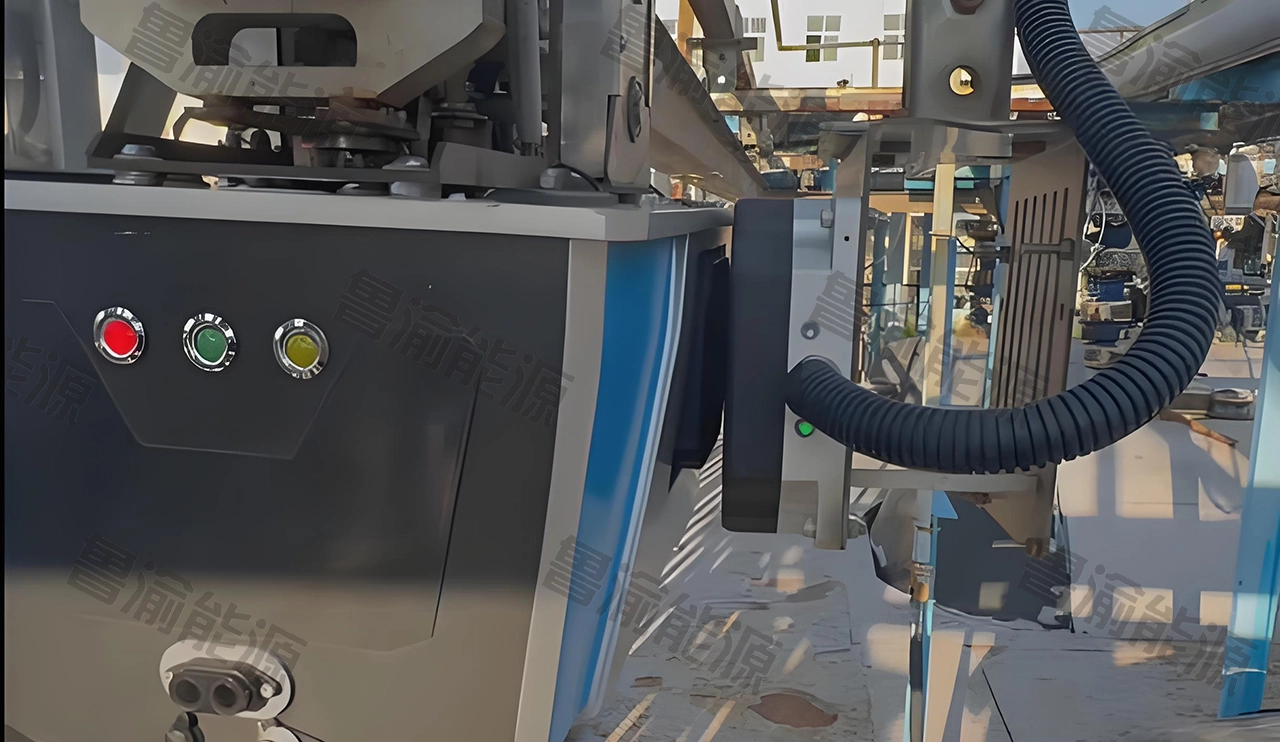
It is worth noting that this 6000W product adopts an integrated design, combining the power conversion unit and the energy coupling unit into one. The size of the transmitting end is 300mm x 300mm x 80mm (with the thickness increasing to 116mm after adding a heat sink), and the size of the receiving end is the same.
In the field of high-power wireless charging, the technical difficulty of integrated design is higher than that of split design - the greater the power, the more heat is generated. How to solve the heat dissipation problem within a limited space is a core challenge that engineers must overcome. The technical team of WIRELESSPT has optimized the thermal management design to ensure the stability of the system during long-term full-load operation while maintaining a compact structure.
The product is equipped with a complete protection mechanism: output overcurrent protection is triggered above 104A, output overvoltage protection is triggered above 61VDC, and the overtemperature protection point is set at 75 ± 2℃. When the system detects an abnormality, it will automatically cut off the output and enter a protection state, and resume standby mode after the fault is resolved.
Communication and Control: "Intelligent Nodes" Integrated into the Automation System
In large automated factories or photovoltaic power stations, equipment often does not operate independently but is uniformly managed by the control system. The WIRELESSPT6000W product supports CAN and 485 communication interfaces and can seamlessly integrate into the upper-level control system.
When multiple devices share the same charging area, the control system can dynamically arrange charging plans based on task priority and battery status to avoid resource conflicts. The status information during charging, including current, voltage, temperature, and fault codes, can be uploaded in real time for remote monitoring by managers.
This "dialogue-capable" ability enables wireless charging devices to evolve from simple energy supply stations to an intelligent node in the automation system. It is no longer an isolated "charging station" but a collaborative whole formed together with robots and the control system.
From Optional to Mandatory: The Turning Point of the High-Power Wireless Charging Market
At the manufacturing base in Yantai with an annual production capacity of 20,000 sets, this 6000W integrated wireless charger has entered the mass production stage. According to the company, the product has completed field verification in multiple typical scenarios: a large inspection robot for a photovoltaic power station, which uses this system to achieve all-weather automatic charging in outdoor environments; a rail Gantry Vehicle (RGV) fleet in a steel mill, which increases equipment utilization by more than 15% through 100A fast charging.
"Early adopters of wireless charging often chose it because they had 'no other option' - such as explosion-proof environments, harsh outdoor conditions, where plug-and-play simply doesn't work," Li Dan concluded. "But now we are seeing more and more customers actively choosing wireless charging because it is more convenient and less troublesome. For high-power equipment, this trend is just beginning."
When the charging speed meets the demands of the equipment, when the reliability can withstand the tests of extreme conditions, and when the installation requirements are lowered to the point where even ordinary engineers can easily master it - wireless charging is moving from being an "optional choice" for special scenarios to a "must-have" for industrial automation.


 EN
EN


 +86 18678901310







 Explosion-proof Wireless Charging