When many enterprises are building dark-light factories and deploying AGV/AMR mobile robots, they often encounter a point that is easily overlooked: the tasks of transportation and inspection can be fully automated, but the charging环节 still cannot do without human intervention. When the robot's battery level drops, it needs to leave the production line and navigate specifically to a centralized charging station to wait for a long time for charging. If the scheduling coordination is not smooth, the unmanned rhythm of the entire production line will be interrupted. And opportunity charging is precisely a charging solution designed to address this pain point - it does not require a dedicated trip to the charging station; instead, charging is hidden in the production gap, becoming the invisible power supply for dark-light factories.
In simple terms, opportunity charging is not a single device, but a completely new robot charging strategy. It is completely opposite to the traditional "battery level drops, then go to the charging station for a long time to charge" model: opportunity charging utilizes the fragmented gaps when the robot stops to charge briefly, such as at the loading and unloading stations, material connection points, waiting queues, and task transfer buffer zones. During the few minutes or even tens of seconds that the robot stops here, it can automatically recharge nearby, charging for as long as needed and charging as much as required, completely following its operation rhythm. There is no need to set aside specific charging time, nor does it require manual insertion, removal, or supervision.
We can use a common metaphor to understand it: traditional charging is like a full-course meal, which must stop all current activities and spend several minutes eating; opportunity charging is more like a casual snack. During the work gap, it stops to replenish a little energy quickly, without interrupting the current work. The repeated scattered short-term charging accumulates to stabilize the battery level within an appropriate range, avoiding a significant drop in battery level, and the robot can continue to undertake tasks, truly supporting 24-hour uninterrupted operation. This is why it is called "invisible power supply".
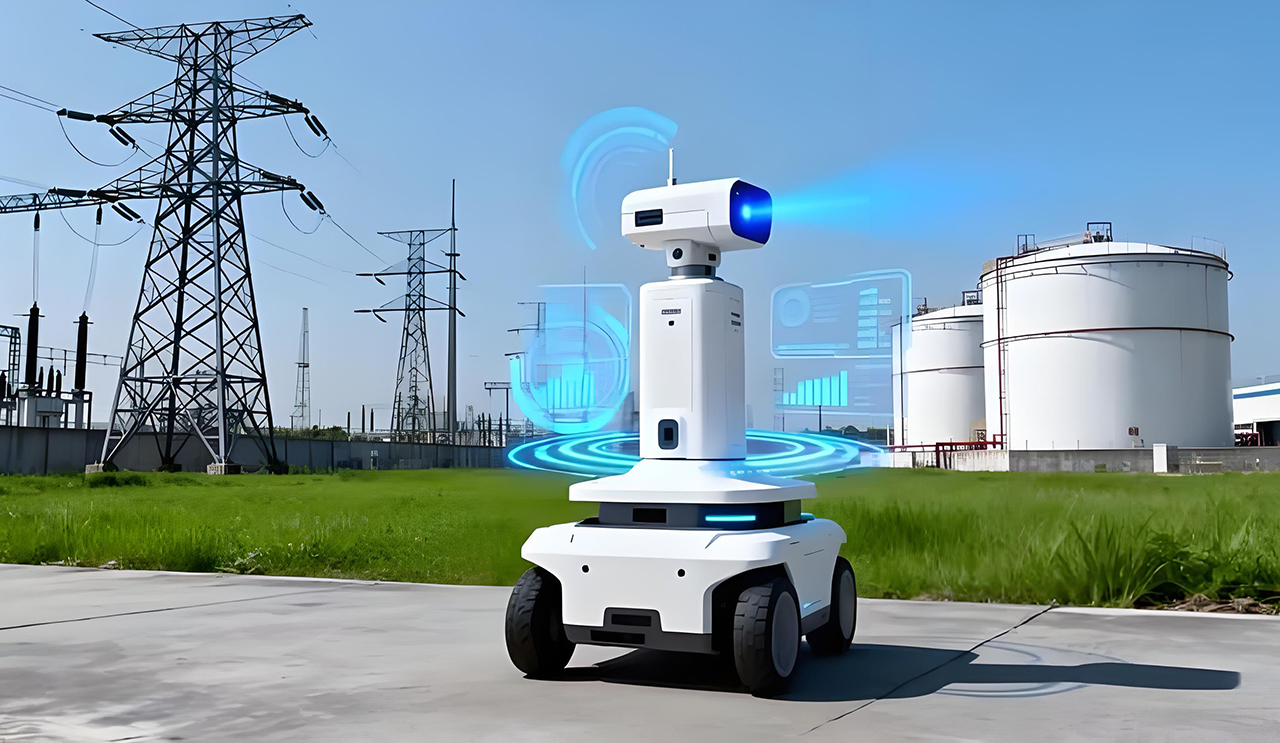
Wireless charging is the ideal carrier for opportunity charging to be implemented in dark-light factories. If it is contact-based charging, precise mechanical contacts need to be accurately aligned, and in dusty or oily environments, the contacts wear out quickly and are prone to sparking, requiring regular maintenance by humans. It is difficult to adapt to unmanned scenarios. The WIRELESSPT wireless opportunity charging system positions the charger at each workstation, and when the robot stops and is in place, it can automatically sense and start charging. There is no precise alignment required, no exposed contacts, and no human intervention throughout the process. It is naturally suitable for special scenarios with high reliability and safety requirements, such as dark-light factories, clean workshops, and explosion-proof workshops.
In actual production lines, this logic can seamlessly connect with the factory's MES and WMS scheduling systems. The scheduling platform reads the battery status of each robot in real time and combines the task schedule to automatically plan the charging timing: when the robot reaches the loading station and waits for material circulation, it automatically charges; when it receives a new task, it immediately cuts off power and leaves to continue running. The charging points are scattered along the work nodes, without the need to plan a large-scale charging area, saving workshop space. For AGV fleets with multi-machine cluster scheduling, opportunity charging can also balance the battery levels of all robots, avoiding concentrated charging that causes production line capacity shortages, and significantly improving the overall equipment utilization rate.
Many factories, when initially implementing unmanned projects, only focused on robot navigation, scheduling, and transportation capabilities, treating charging as an ancillary process. Eventually, they discovered that: although automation ran, it was held back by charging. Once there was the need for dedicated personnel to supervise charging and handle connection faults, dark-light factories no longer met the name. The core value of opportunity charging is to fill the last missing link in the unmanned closed loop - making charging no longer an independent process but an imperceptible part of the production process.
Of course, opportunity charging is not a universal solution. It is more suitable for mobile robot scenarios with stable intermittent stopover points and the need for long-term continuous operation. It maintains its power supply through multiple small-scale recharges. It has specific requirements for the battery, wireless charging module, and scheduling coordination. Point planning and type selection matching need to be done in combination with the production line rhythm and robot routes.
As intelligent manufacturing continues to upgrade, the competition in black light factories has gradually shifted from "whether they can work automatically" to "whether they can operate continuously and stably autonomously". What can be seen are the robots constantly moving around, while what cannot be seen are the charging systems scattered throughout the production line, quietly replenishing power during the intervals. There is no need to go to the charging station specifically; charging is integrated into each stop. This is the invisible endurance of the black light factory.


 EN



 +86 18678901310









 Explosion-proof Wireless Charging