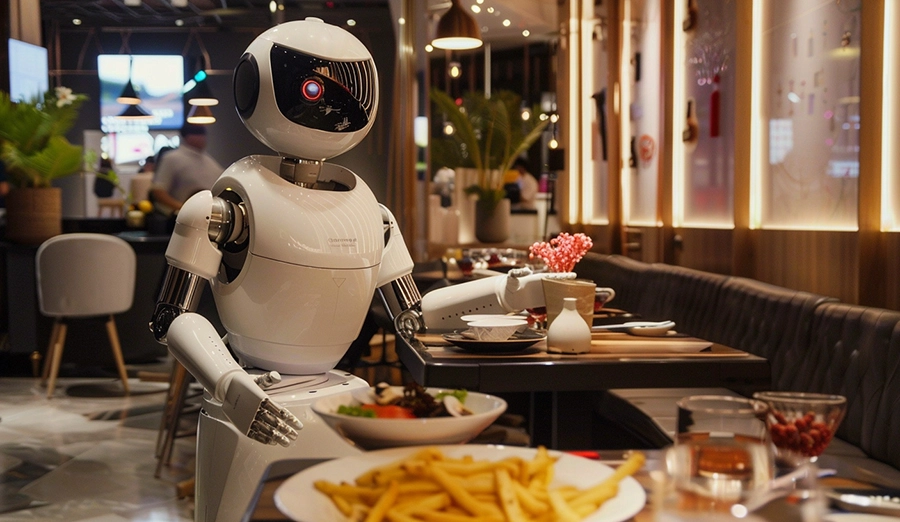
In 2026, humanoid robots began to be mass-produced and moved out of the laboratory. Products from companies like Figure, Yushu, and Zhiyuan have successively entered factories, commercial spaces, and even household scenarios. However, battery life has always been a major drawback: mainstream models need to be charged after working for 2 to 4 hours, and wired charging requires manual intervention, while fixed-contact charging is not accurate.
The industry is exploring different charging solutions. Some companies integrate induction coils directly into the soles of the robots, allowing the robots to recharge on the charging plate, which takes approximately one hour to fully charge and also transmits running data. This approach turns charging into "just stand on it", eliminating the need for arm insertion and precise interface connection. Some chip manufacturers are also promoting the application of wireless power supply technology in humanoid robot docking stations, supporting power ranges from 20W to 2.2kW, and completing charging identification and verification through NFC communication.
From industry data, the penetration rate of wireless charging receivers for humanoid robots is rapidly increasing. The magnetic resonance coupling solution, due to its large position tolerance, has become the mainstream technical route.
WIRELESSPT has over a decade of experience in industrial-level magnetic coupling resonant wireless charging. Its product power covers 10W to 30kW, and it has mature technical bases in terms of offset tolerance, sealing protection, and intelligent management. The charging needs of humanoid robots are different from those of industrial equipment - battery capacity is relatively small, charging postures are diverse, and the receiving end space is limited. WIRELESSPT can provide evaluation of wireless charging solutions for humanoid robot manufacturers with demands, adapting to specific models' battery parameters, structural space, and operation scenarios.
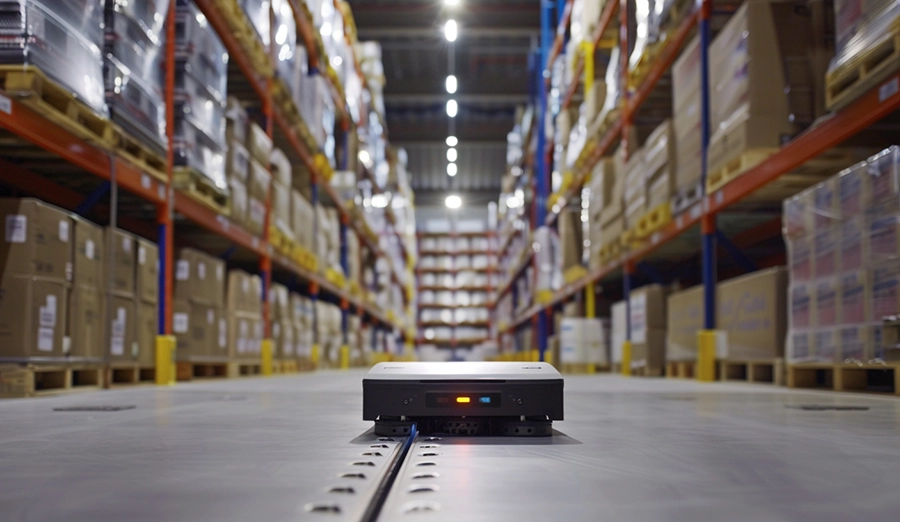
The charging problem of humanoid robots is essentially the same as that faced by AGVs and inspection robots: as equipment moves towards "automation", charging can no longer be a "humanized" operation. Whether wireless charging can be the answer depends on whether the solution can truly adapt to the shape and scenario of the robot, which requires manufacturers and solution providers to work together to solve this problem.


 EN
EN


 +86 18678901310






 Explosion-proof Wireless Charging